
From the Stacks: Quick Takes on Books, Pods & Docs (January 2026)
Two DCP memoirs, two research deep-dives, and the story of a sperm bank
My list of books, podcasts, and documentaries related to donor conception keeps growing. "From the Stacks" is where I will share my thoughts on what I've been reading, watching, and listening to. I approach these with as much of a critical eye as I can manage as a solo parent of two busy little kids. These aren't formal reviews, just my quick and honest take. A quick note: I purchase or borrow everything independently and receive no compensation from authors, publishers, or affiliate links. Have a suggestion? Send it my way!
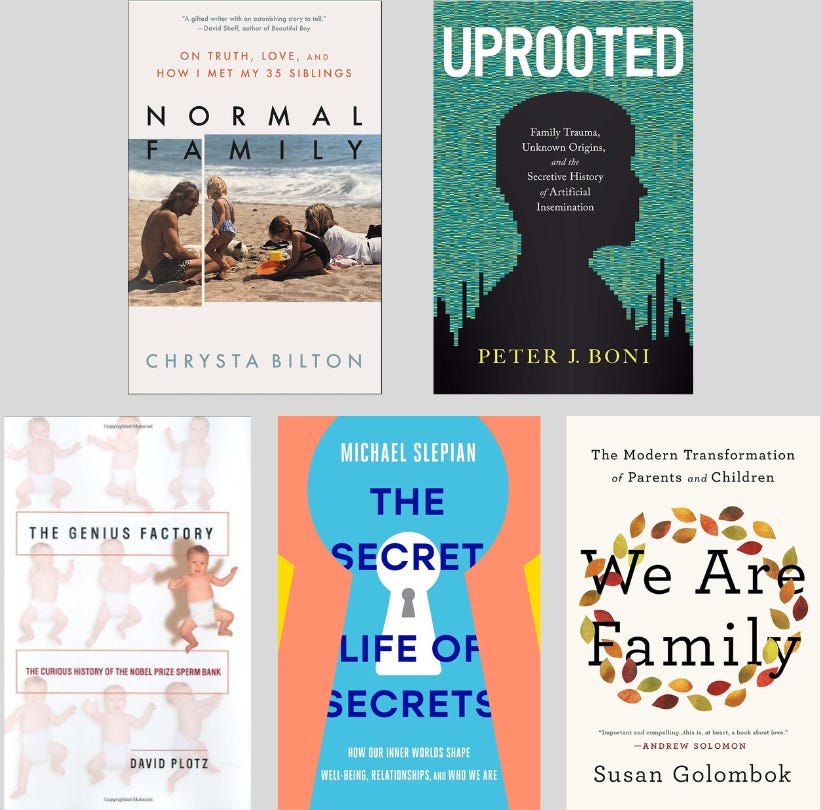
Chrysta Bilton's Normal Family (2022) is a compelling memoir that transcends being merely a donor conception narrative to offer readers a curious coming-of-age story. Bilton navigates life with her larger-than-life mother and known donor—who was simultaneously a secret sperm bank donor—creating a uniquely complex family constellation. What stands out to me is her evolution from initial disinterest in connecting with her donor siblings to genuine openness, a trajectory that feels authentic rather than prescriptive. Beyond the donor conception elements, the book captures a specific moment in American lesbian culture and community that may feel revelatory to readers unfamiliar with that era and context. I’m trying to figure out where to watch the 2011 Donor Unknown documentary about her biological father.
Peter Boni's Uprooted (2022) is an important historical narrative of donor conception, as he learned at age fifty that he was donor-conceived in 1945. What makes his book particularly valuable is how it illuminates a world that can no longer exist: the era when secrecy was structurally enforced, when a donor-conceived person's discovery depended on family disclosure rather than genealogical databases. Boni weaves his personal odyssey with meticulous research into the early history of artificial insemination, its legal frameworks, and the deliberate concealment that defined the practice. His story is an archive of a reproductive landscape that has transformed (though maybe not as much as we’d like).
In We Are Family (2020), Susan Golombok draws on four decades of longitudinal research on donor conception, surrogacy, and nontraditional families into one accessible book. Her research provided what many needed: proof that children thrive in diverse family structures when there's love, stability, and honesty. Her data consistently shows that early disclosure benefits both children and parents, that family function matters more than family form, and that fears about nontraditional parenting are largely unfounded. The book reads more like a retrospective of her career than a push into new territory. Folks seeking cutting-edge thinking or engagement with emerging tensions in the donor conception landscape won't find it here.
Michael Slepian's The Secret Life of Secrets (2022) offers valuable research on the psychology of secrecy, including what secrets are, why we keep secrets, and how keeping them shapes us. His own discovery as an adult that he's donor-conceived gives the book unexpected resonance. All in all, a digestible, compelling read. The chapter on how children come to understand secrets was my favorite. One thing made me uneasy: Slepian provides compassionate advice for living with secrets, framing secrecy as sometimes protective. I can see how his advice could just as easily be used to help parents maintain secrecy around aspects of donor conception.
David Plotz's The Genius Factory (2005) tells the story of the Repository for Germinal Choice, a notorious 1980s "Nobel Prize sperm bank" founded on eugenicist ideals. On one level, it's a fascinating American history, a story about eugenics, Silicon Valley, Cold War anxieties about genetic decline, racism, and how a fringe idea got repackaged as consumer choice. On another, it’s a journey into the actual lives of several donor-conceived people born through the Repository. The interviews help reveal what can happen when genetic expectations are loaded onto children and how these expectations play out when donors and half-siblings connect. There’s a 2017 documentary of the same name that follows up on the offspring of the bank. (I haven’t watched it.)
I’ve been lucky enough to receive an advanced copy of the book ‘ Inconceivable ‘ by Rebecca Coxon (dcp and egg donor). I’m enjoying reading it so far, will keep you posted - believe it’s due for official release mid March