
From the Stacks: Quick Takes on Books, Pods & Docs (June 2026)
Four novels with DCP characters and two nonfiction reads that might make you think
My list of books, podcasts, and documentaries related to donor conception keeps growing. "From the Stacks" is where I will share my thoughts on what I've been reading, watching, and listening to. A quick note: I purchase or borrow everything independently and receive no compensation from authors, publishers, or affiliate links. If you are interested in other creative works that feature donor-conceived characters, check out the Parts of Me DCP Stories Collection.
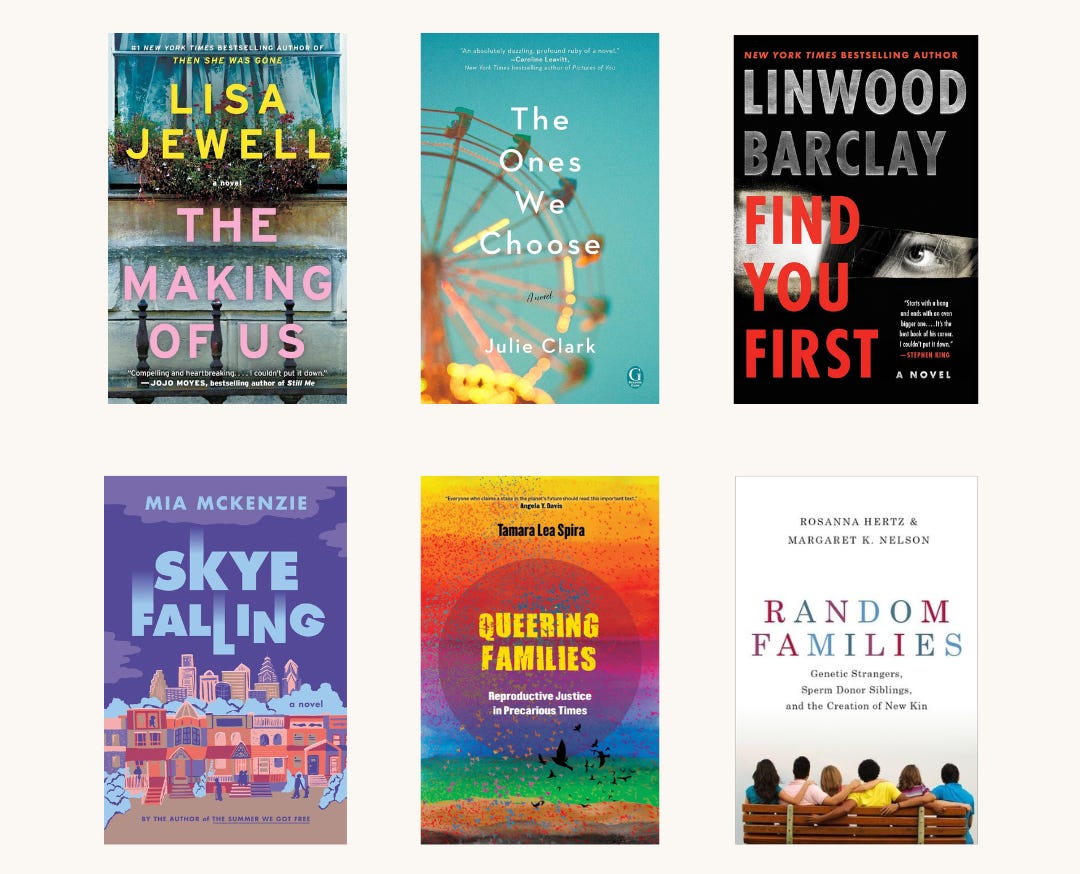
Queering Families: Reproductive Justice in Precarious Times - Spira (2025)
Official Blurb: Queering Families traces the shifting dominant meanings of queer family from the late twentieth century to today. With this book, Spira highlights the growing embrace of normative family structures by LGBTQ+ movements—calling into question how many queers, once deemed unfit to parent, have become contradictory agents within the US empire’s racial and colonial agendas. Simultaneously, Queering Families celebrates the rich history of queer reproductive justice, from the radical movements of the 1970s through the present, led by Black, decolonial, and queer of color feminist activists. Ultimately, Spira argues that queering reproductive justice impels us to build communities of care to cherish and uphold the lives of those who, defying normativity’s violent stranglehold, are deemed to be unworthy of life. She issues the call to lovingly wager a future for the world’s children, the planet, and all living beings against all odds, and in increasingly perilous times.
For the donor conception community, Chapter 3 is particularly relevant. Using the Donor Sibling Registry and Wendy Kramer’s books as case studies, the author shows how donor conception advice and advocacy (often rooted in genuine care and real testimonies of harm) has organized itself around genetic connection as a core solution. Spira points out that when donor conception spaces position genetic connection as “the best practice” (use a known donor, do DNA testing to find relatives, maintain regular contact with donor siblings and donors), that framing can align with the messages used by pro-family movements to delegitimize non-genetic, non-traditional families (children must be raised by their biological mother and father). The underlying logic is similar: without genetic connection, something is missing/broken. We inherited that logic from a bionormative world that needs genetic connection to mean something very specific—that it's the key to family legitimacy, to wholeness, to identity. Advocacy and advice built from that logic, however well-intentioned, is still operating inside it. Spira demands that we look closer: What social and political movements benefit from those messages?
Based on over 350 interviews with donor-conceived people (ages 10-28), their parents, and donors across the U.S., the book looks at how some people are transforming “genetic strangers” into new possibilities for kinship. The first section of the book looks at the conditions that enable contact among donor siblings, how parents navigate donor selection and the initiation of engagement in “networks of genetic strangers”, and how DCP construct their own understanding of donors and genetic networks. In the second session, the authors describe five specific networks that vary in the era in which conception occurred, the ages of the DCP, the value placed on connections, and interpersonal dynamics. Do note that the demographic similarities of the families included in the book are significant. I appreciate that the book takes seriously how DCP and families choose to engage (or not engage) and resists the assumption that genetic connection automatically creates obligation or belonging.
Skye Falling - McKenzie (2021)
Skye Ellison is 38, Black, queer, and has spent her adult life avoiding anything that might require her to stay in one place. She runs a successful travel company, lives out of a suitcase, and returns to her hometown of West Philly only occasionally to decompress. When she was 26 and broke, a childhood friend named Cynthia asked her to donate eggs to help her have a child. Skye agreed and didn’t think much about it afterward. Twelve years later, at an art opening, a kid named Vicky walks up and introduces herself as “her egg.” Cynthia has died of cancer, and headstrong Vicky wants to know who Skye is. Skye’s first instinct is to flee, but something about Vicky won’t let her. For the first time in years, Skye stays put long enough to reckon with everything she’s been running from. While the book centers Skye’s point of view, Vicky’s thoughts and feelings get decent space. This book also won the 2022 Lambda Literary Award. (I loved this as an audiobook!)
Find You First - Barclay (2021)
Tech millionaire Miles Cookson is diagnosed with a fatal, hereditary condition and realizes that the nine children he fathered as a sperm donor two decades earlier may have inherited it. Determined to warn them, Miles sets out to find them. He connects first with Chloe, an aspiring documentary filmmaker who has already been searching for genetic relatives. As Miles tracks down his donor-conceived children, they begin disappearing. The thriller’s second storyline follows Jeremy Pritkin, a wealthy and powerful man with a predilection for underage girls. As the body count rises, Miles and Chloe race to uncover who is behind the killings before there are no children left to find. Three DCP characters are featured in the multi-narrator format. Content Warnings: Violence and murder (multiple characters killed or injured on-page); sexual exploitation of minors (Pritkin subplot clearly inspired by Jeffrey Epstein).
The Ones We Choose - Clark (2018)
Geneticist Paige Robson has spent her career studying why some fathers choose to stay while others leave, a question rooted in her own father’s abandonment. When she decides to become a mother, she selects an anonymous sperm donor, wanting to build a family without paternal complication. Years later, her 8-year-old son Miles begins asking questions about his biological father. When the donor unexpectedly enters their orbit, a chain of revelations unfolds, forcing Paige to confront what family actually means. I love a book with multiple narrators, and this one spends time on a broad ecosystem of people connected to a donor-conceived person: the recipient parent, grandparents, aunts, cousins, the donor and his relatives. It’s clear the author did her homework observing in SMBC spaces online.
This novel follows three adults who were conceived anonymously via sperm donation in the UK and find each other through a donor sibling registry. Lydia is a wealthy self-made millionaire carrying emotional scars from a traumatic childhood; Dean is a confused 21-year-old single father struggling after his girlfriend’s death; and Robyn is an eighteen-year-old med student concerned that her boyfriend might be her biological sibling. Running parallel is the story of Daniel, their sperm donor, dying of cancer in a hospice. Every DCP’s arc is organized around a father figure — Dean’s absence of one and struggle to embrace the role, Lydia’s emotionally unavailable one, Robyn’s beloved one — reinforcing a traditional ideology in which fathers are central to healthy development.
Have you read any of these? What landed for you? What didn’t? Send your thoughts my way!
Related Posts
From the Stacks: Quick Takes on Books, Pods & Docs (July 2025)
From the Stacks: Quick Takes on Books, Pods & Docs (January 2026)
Have you read Kerry Washington’s memoir? A through line is discovering she was donor conceived